Seed Starting Mix and Containers: What Seedlings Need
Choose the right seed starting mix and containers for healthy seedlings. Learn why soilless mix beats garden soil, cell sizes by crop, and avoiding damping-off.
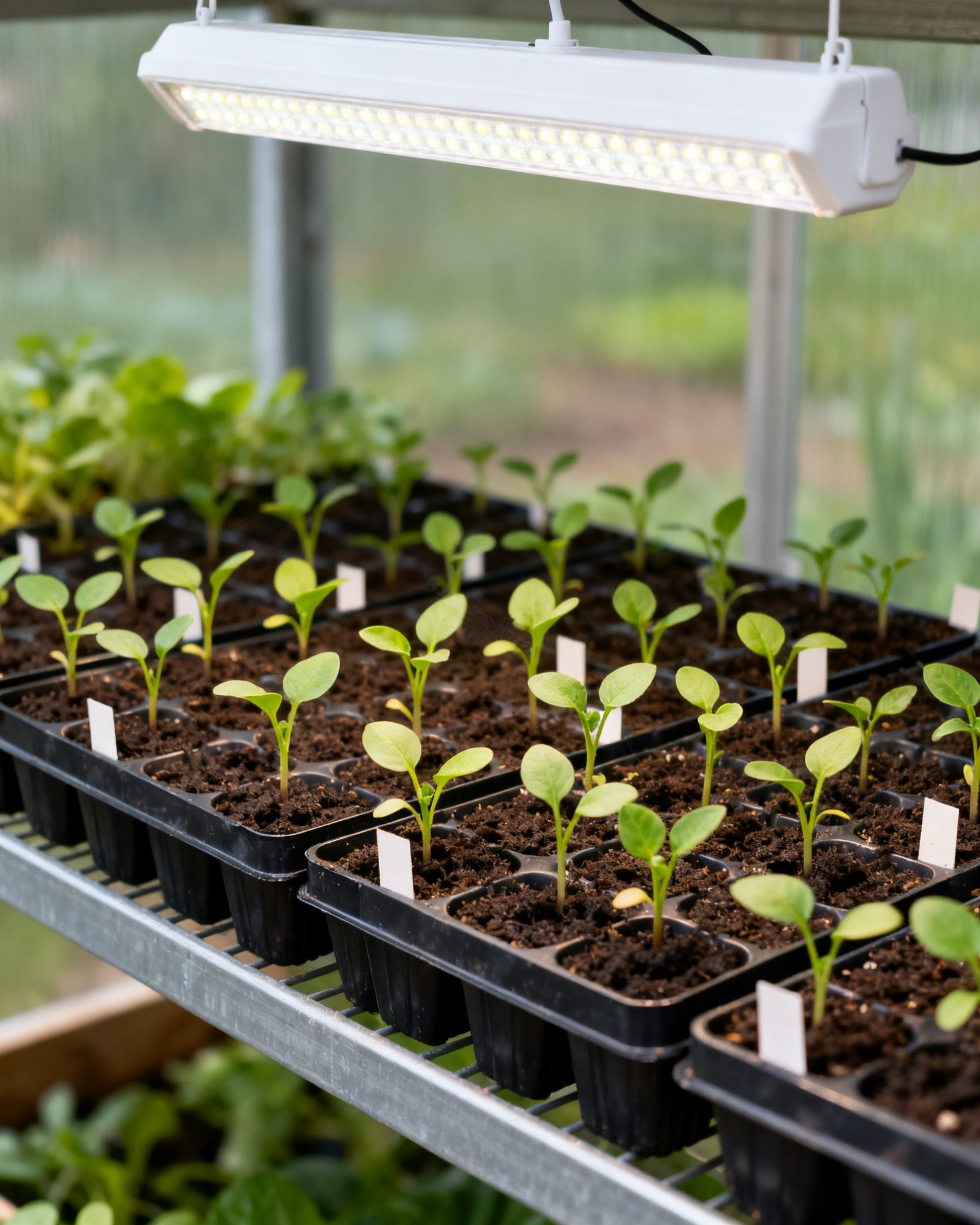
A good seed starting mix is soilless, light, and moist before you fill a single cell. Garden soil is too dense for containers, may carry weed seeds and pathogens, and weighs about 75 pounds per cubic foot, while a good soilless mix weighs about 10 pounds per cubic foot. That difference matters: roots need air as much as water, and a heavy mix stays wet too long. The container matters too. Almost any clean container that drains and is at least 2 inches deep can work, but matching cell size to the crop and cleaning reused trays are the habits that separate sturdy transplants from weak ones.
Why soilless mix, not garden soil
Garden soil in a flat or pot compacts, holds too much water, and can introduce damping-off organisms and weed seeds. Soilless mixes are made from materials such as sphagnum peat moss, coconut coir, perlite, vermiculite, composted bark, compost, and rice hulls. They hold moisture while letting excess water drain, and they reduce soil-borne disease such as damping-off (Clemson Extension).
Most potting mixes carry enough fertilizer to grow a seedling for at least 6 weeks; some labels say 6 to 8 weeks after germination (University of Maryland Extension). That means you do not need to feed at sowing. Once the first true leaves appear, Clemson’s practice is to feed at every other watering with a water-soluble starter fertilizer, plain water between feedings. Rinse liquid fertilizer off the leaves, because young seedlings are easily burned (Maryland Extension). For more on that balance, see watering and fertilizing seedlings without drowning them.
Wet the mix before you fill
Dry peat repels water. Moisten the mix before filling containers; it should feel as moist as a wrung-out sponge. Fill containers to within one inch of the top (Maryland Extension). If you skip this step, water runs down the sides and the mix stays dry in the middle even after several waterings.
Containers: flats, cells, and pots
A standard plastic flat is 10 inches by 20 inches. Depending on cell size, 10 to 120 plants fit in one flat (Maryland Extension). That range is wide because cell size varies enormously. Small cells suit quick, small seedlings; larger cells suit crops that will grow in place for several weeks.
Almost any clean container that drains and is at least 2 inches deep works. Reused containers are fine if they are cleaned first. For trays that held seedlings before, wash them and soak them for 1 to 2 minutes in 1 part chlorine bleach to 10 parts water, then rinse (Maryland Extension). This is the same sanitation step recommended after damping-off.
Cell trays vs pots
Cell trays are efficient for sowing many seeds in a small space, but they dry out faster and crowd roots sooner. Individual pots give each plant more room and are easier to move up. The choice depends on how long the seedling will stay indoors and how large it will get. Tomato, pepper, and eggplant started one per cell are moved up 2 to 3 weeks after germination (Maryland Extension). Crops that resent root disturbance, such as cucumber and squash, do best in a pot they can be set out from without breaking the root ball.
Suggested cell or pot size by crop
| Crop group | Suggested cell or pot size |
|---|---|
| Lettuce, beets, spinach, kale, and other greens | 3 to 6 square inches |
| Squash, cucumber, broccoli, and cabbage | 4 to 9 square inches |
| Tomato, eggplant, and pepper | 9 to 16 square inches |
Source: University of Maryland Extension.
Within each range, a crop that stays indoors longer needs the bigger cell: a pepper that may need 8 to 10 weeks indoors benefits from the larger end of its range, while a lettuce seedling that will go out in 2 to 4 weeks can start in a smaller cell.
Biodegradable pots and the rim problem
Peat, coir, and manure pots can go into the ground with the plant, but remove the base and any rim that would sit above the soil line. An exposed rim wicks water away from the roots (Maryland Extension). Tear off the top edge before planting so the pot is buried completely.
Soil blocks
Soil blocks are made by pressing moist mix into a tool that forms freestanding cubes. They avoid a plastic container entirely, but they dry out faster than a flat and need careful watering. They work best for crops that will be set out before roots need much space.
Filling and sowing
- Moisten the mix to the feel of a wrung-out sponge.
- Fill containers to within one inch of the top and firm gently.
- Sow at about twice the seed’s diameter; a seed 1/8 inch wide goes about 1/4 inch deep (Maryland Extension). The Maryland germination page gives the rule as 2-3 times the seed’s diameter. Lettuce and celery germinate best in light and are left uncovered or barely covered.
- Cover with a clear dome or plastic until sprouts appear, then remove it as soon as they do.
- Keep the mix at 65° to 75°F for most vegetable seeds (Maryland Extension).
For a full sequence from packet to transplant, see how to start seeds indoors, step by step.
Light, temperature, and water after sowing
A window is seldom enough light; stems stretch and lean. Keep fluorescent or LED fixtures 2 to 6 inches above the plants, on for 14 to 16 hours a day with an outlet timer (Maryland Extension). Clemson Extension gives 16 to 18 hours of bright light and keeps tubes 2 to 4 inches above the seedlings, raising them as plants grow. After potting up, keep the tops of plants 1 to 2 inches from the lights (Maryland Extension).
After germination, seedlings do well with a 55 to 60°F night temperature and a 65 to 70°F day temperature (Maryland Extension). A small fan near seedlings from the two-true-leaf stage makes them sway and begins toughening them; it also dries them faster, so watch moisture (Clemson Extension).
Water when the top of the mix is nearly dry. Water from the top until it drains, or from below by setting containers in a shallow tray. Clemson Extension suggests filling a tray with 1 to 2 inches of water and letting the cells absorb it for 3 to 10 minutes. Saturated media starve roots of oxygen, so do not leave containers standing in water.
What goes wrong
Dense mix and no drainage
The most common container mistake is using garden soil or a heavy mix that stays wet. Roots need air. A mix that holds water like a sponge and a container without drainage holes create the conditions for damping-off, caused by water molds that need free water. Seedlings under lights die of it when the mix is poorly drained or kept too wet. It can kill seeds before they emerge and collapse young seedlings. Infected seedlings cannot be saved: remove and discard them with their mix, wash containers, and soak them for 1 to 2 minutes in 1 part chlorine bleach to 10 parts water, then rinse (Maryland Extension). For the full picture, see damping-off: why seedlings collapse and how to prevent it.
Dry peat and uneven watering
Peat that was not moistened before filling repels water. Water runs down the inside of the container and out the bottom while the center stays dry. Moisten the mix first, then water from the top until it drains, or from below as described above.
Sowing too early
A common mistake is sowing too early, which gives tall, root-bound plants that do poorly in the garden (Maryland Extension). Match the sowing date to the crop’s indoor time: leafy greens 2 to 4 weeks; cabbage, broccoli, and cauliflower 4 to 6 weeks; cucumber, squash, and melons 3 to 5 weeks; tomato 5 to 6 weeks; pepper, eggplant, and onion 8 to 10 weeks (Maryland Extension). Clemson Extension’s table gives longer ranges for some crops: broccoli, Brussels sprouts, cabbage, cauliflower, collard, and kale 5 to 7 weeks; lettuce 5 to 7 weeks; tomato and eggplant 6 to 8 weeks; pepper 8 to 10 weeks. Some pepper types need 12 weeks from seed (Maryland Extension).
Crowding in the flat
Leaving seedlings crowded in the flat too long is one of the most common mistakes. Plants started together in a flat are moved to their own containers shortly after the first true leaves appear (Maryland Extension). Hold seedlings by a leaf or the cotyledons, never by the stem.
Reused containers that were not cleaned
Old mix and residue can carry pathogens. Wash and bleach-soak reused trays and pots before filling them again. Clean containers are part of the same prevention strategy as soilless mix and careful watering.
Matching mix and container to the crop
Beans, corn, and carrots do not do well as transplants and should be sown directly in the garden (Clemson Extension). Cucumber, squash, melons, corn, and beans can be grown for 2 to 4 weeks as transplants without potting up: sow two or three seeds per cell and keep the strongest (Maryland Extension). That approach uses the cell tray efficiently and avoids the root disturbance that these crops dislike.
For crops that will be potted up, start in a smaller cell and move up as roots fill it. Tomato, pepper, and eggplant started one per cell are moved up 2 to 3 weeks after germination (Maryland Extension). A tomato sown 5 to 6 weeks before planting out makes a stocky 8- to 10-inch plant; the ideal transplant is about as wide as it is tall (Maryland Extension).
A soilless mix and a clean, drained container are the foundation. Get those right, water carefully, and give the seedlings enough light, and the rest of the indoor season goes more smoothly.
Common questions
Can I use garden soil to start seeds indoors?
No. Garden soil is too dense for containers, weighs about 75 pounds per cubic foot, and may carry weed seeds and pathogens. A soilless mix weighs about 10 pounds per cubic foot and reduces soil-borne disease such as damping-off.
What is the best container for starting seeds?
Almost any clean container that drains and is at least 2 inches deep works. A standard plastic flat is 10 by 20 inches and holds 10 to 120 plants depending on cell size. Match cell size to the crop and clean reused trays before filling.
Do I need to wet the seed starting mix before filling containers?
Yes. Dry peat repels water, so moisten the mix until it feels like a wrung-out sponge before filling. Fill containers to within one inch of the top. If you skip this step, water runs down the sides and the center stays dry.
How do I clean reused seed trays?
Wash them, then soak for 1 to 2 minutes in 1 part chlorine bleach to 10 parts water, and rinse. This is the same sanitation step recommended after damping-off. Clean containers are part of preventing disease.
When should I move seedlings from a cell tray to a larger pot?
Plants started together in a flat are moved shortly after the first true leaves appear. Tomato, pepper, and eggplant started one per cell are moved up 2 to 3 weeks after germination. Leaving seedlings crowded too long is a common mistake.
Read next
Grow Lights for Seedlings: Distance, Hours and Setup
How far to hang grow lights above seedlings, how many hours a day they need, LED versus fluorescent, and the setup mistakes that leave plants leggy and weak.
Seed Germination Temperature, Domes and Heat Mats
Most vegetable seeds germinate best at 65° to 75°F. How to use domes and heat mats, when to remove the cover, and how to cool seedlings after sprouting.
How to Start Seeds Indoors, Step by Step
A practical, step-by-step guide to starting vegetable and herb seeds indoors: timing, containers, mix, warmth, light, watering, potting up and hardening off.